






Portable Seawater RO Plant, Water Maker & Mobile Seawater Desalination: The Complete Technical Guide
Clean freshwater from the sea is no longer a luxury reserved for large governments and massive infrastructure projects. Today, a portable seawater RO plant, a compact water maker, or a rapid-deployment mobile seawater desalination system can deliver safe, WHO-standard drinking water to virtually any coastal location on earth - within hours, not months.
But the terminology can be confusing. Portable seawater desalination. Mobile seawater RO plant. Water maker. Emergency use seawater desalination. Each term describes a real and distinct category of equipment - and confusing them leads to expensive purchasing mistakes that Ultra Tec UAE helps clients avoid every single day.
This complete technical guide covers all seven of these technologies and keyword categories in a single, comprehensive reference - explaining what each system is, how it works, who needs it, and how Ultra Tec UAE delivers the right solution for your exact situation.
What is a Portable Seawater RO Plant
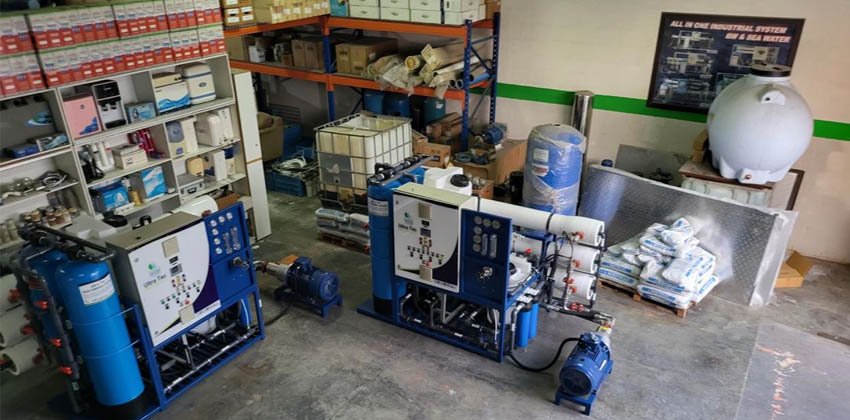
A portable seawater RO plant is a complete, self-contained water production system that converts raw ocean water into clean drinking water using reverse osmosis membrane technology - without requiring any fixed construction, foundation work, or permanent infrastructure.
The word "portable" is critical here. It does not simply mean small. It means the entire system - intake screening, pre-treatment filtration, high-pressure RO membranes, post-treatment disinfection, controls, and chemical dosing - arrives at your location fully assembled, factory-tested, and ready to produce water within hours. You connect it to seawater, power, and a product water outlet. That is all.
What Portable Seawater Desalination Actually Delivers
Portable seawater desalination delivers something that was technically impossible for most of human history - the ability to take ocean water containing 35,000 to 45,000 milligrams of dissolved salt per litre and transform it into fresh water containing less than 500 milligrams per litre - in a system small enough to ship by truck, helicopter, or cargo plane to almost any location on earth.
Modern portable seawater RO plants achieve salt rejection rates above 99.4 percent. They incorporate multi-stage pre-treatment to handle turbid, biologically active coastal water. High-pressure pumps and energy recovery devices keep power consumption between 3.5 and 5 kWh per cubic metre - far below older generation systems. And PLC-based control panels allow fully automated 24/7 operation with minimal on-site supervision.
Who Uses Portable Seawater Desalination Systems
- Remote construction and infrastructure projects on coastlines where no municipal water reaches and trucking costs are prohibitive.
- Offshore oil and gas facilities where workers need daily drinking, cooking, and process water with zero tolerance for supply interruption.
- Island resorts and eco-lodges that cannot depend on aging local water infrastructure to serve guests reliably.
- Governments and municipalities supplementing municipal supply during drought conditions, seasonal demand peaks, or infrastructure failures.
- Humanitarian organizations providing emergency clean water in disaster-affected coastal regions and refugee situations.
💡 Key fact: A portable seawater RO plant is not a compromise version of a permanent plant. It uses the same membrane technology, the same pressure vessel design, and the same treatment standards as large fixed facilities - just packaged for mobility and rapid deployment.
What is a Water Maker - Marine Desalination Explained
A water maker is the marine industry's term for a compact, vessel-installed seawater reverse osmosis desalination unit. It is designed from the ground up for life aboard a boat - compact enough to fit under a berth or inside an engine room bulkhead, quiet enough to run while the crew sleeps, and efficient enough to run from a vessel's 12V or 24V DC electrical system without draining the batteries faster than the alternator or solar panels can recharge them.
The term was coined by marine equipment manufacturers who wanted a user-friendly name that made sense to sailors rather than engineers. A water maker quite literally makes fresh water - from the sea - while your boat is underway or at anchor. It gives sailors, fishermen, and offshore charter operators genuine water independence.
How a Water Maker Works Aboard a Vessel
Seawater enters through a through-hull fitting and passes through a seawater strainer and pre-filters before reaching the high-pressure pump. That pump - typically producing 55 to 70 bar of pressure for seawater applications - forces the water through compact spiral-wound RO membrane elements. Fresh permeate water collects on the low-pressure side and flows directly into the vessel's water tanks. Concentrated brine is discharged back to sea through a separate outlet.
The entire system operates automatically once switched on. Modern water makers include automated flush cycles that protect membranes from biological fouling when the system is idle - extending membrane life even when the boat sits in a marina for weeks between passages.
- Small recreational units (12V DC): 30 to 60 litres per hour - sufficient for a couple on an ocean passage.
- Medium units (24V DC or 220V AC): 60 to 200 litres per hour - suitable for a crewed yacht or small charter vessel.
- Large commercial marine units: 200 to 1,000+ litres per hour - for commercial fishing boats, patrol vessels, and offshore support craft.
Ultra Tec UAE supplies the full range of Sea Recovery water makers and marine desalination systems for vessel owners and commercial marine operators across the UAE and GCC.
What is a Seawater RO Plant - Fixed vs Portable
The term seawater RO plant covers a broad spectrum - from a compact skid-mounted portable unit producing 5 cubic metres per day to a massive fixed coastal facility producing hundreds of thousands of cubic metres per day for an entire city. What they share is the core technology: reverse osmosis membranes that physically separate dissolved salt from ocean water under high pressure.
Understanding the difference between fixed and portable seawater RO plants is essential for any buyer or project manager making procurement decisions.
Fixed Seawater RO Plants
A fixed seawater RO plant is built permanently at a coastal location. It requires civil construction - intake channels or boreholes, concrete equipment foundations, permanent electrical infrastructure, chemical storage facilities, and brine outfall systems. Construction timelines range from several months to years depending on scale. Once built, it serves that location permanently - it cannot be moved without effectively dismantling and rebuilding it elsewhere.
Fixed plants make sense for permanent municipal or large industrial water supply at a single stable location where demand is consistent, long-term, and large enough to justify the capital investment in civil infrastructure.
Portable Seawater RO Plants
A portable seawater RO plant delivers the same reverse osmosis water treatment capability - without any of the civil construction. It arrives pre-built on a skid, trailer, or inside a containerized enclosure. Setup involves connecting four services: seawater in, brine out, power in, product water out. The system begins producing water within hours.
Ultra Tec UAE's containerized RO plants represent the most advanced form of portable seawater desalination - factory-assembled, pre-commissioned, and fitted with pressure exchanger energy recovery systems that consume less than 3.0 kWh per cubic metre, which is a 60 percent reduction compared to conventional SWRO systems.
When a Portable Seawater RO Plant Makes More Sense Than a Fixed One
- When the project has a defined end date - construction projects, temporary operations, event water supply.
- When the location is remote or access is difficult - offshore platforms, islands, disaster zones.
- When speed of deployment matters - emergency situations cannot wait for months of civil construction.
- When future relocation is likely - mining operations that move, military deployments that change, NGO missions that redeploy.
- When minimizing capital expenditure is a priority - portable systems eliminate civil construction costs entirely.
Mobile Seawater RO Plant - Mobility as a Strategy
A mobile seawater RO plant is specifically designed and engineered to be redeployed multiple times across different locations during its operational life. This is a more demanding engineering requirement than simply being portable - it means the system must withstand repeated loading, transport vibration, unloading, reconnection, and recommissioning without mechanical degradation or performance loss.
Mobility as a deliberate design strategy changes how a seawater RO plant is built. Every component mounting point must handle road and sea vibration loads. Pipe connections must be quick-disconnect rated for hundreds of reconnection cycles. Control panels must be sealed to ingress protection ratings suitable for outdoor deployment in diverse climates. Structural frames must be rated for container stacking and crane lifting loads without distortion.
Mobile Seawater RO Plant Configurations
- Trailer-Mounted: The entire system sits on a road-legal trailer. A standard tow vehicle repositions it along any coastline within hours. No crane required - the system operates directly on its trailer wheels. This is the fastest and most flexible mobile seawater RO plant configuration for land-based deployments.
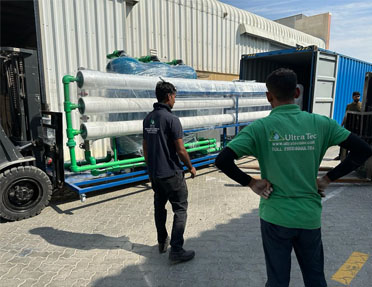
- ISO Container Mounted: All equipment is permanently installed inside a 20ft or 40ft ISO shipping container. The container provides full weather protection and ships globally by standard ocean freight. Ultra Tec UAE's containerized seawater RO plants use this configuration - complete with remote monitoring systems that allow flow rates, pressure, salinity, and system status to be monitored and adjusted from any location via internet connection.
- Skid-Mounted with Lifting Points: A compact steel frame assembly with certified lifting points for crane or forklift movement. Suits offshore platform deck transfers, vessel installation, and tight-space deployments where trailers and containers cannot access.
Industries That Rely on Mobile Seawater RO Plants
- Oil and Gas: Platform operators, drilling contractors, and offshore service companies use mobile seawater RO plants as the primary fresh water supply on platforms where no shore connection exists. The industrial RO solutions Ultra Tec UAE supplies to offshore operators include full remote monitoring capability - critical for unmanned or minimally staffed platforms.
- Military and Defense: Armed forces operating near coastlines use mobile SWRO plants for complete water supply independence in forward operating bases and deployed positions.
- Large-Scale Construction: Coastal infrastructure, port development, and marine construction projects use mobile seawater RO plants throughout the construction period - then relocate them to the next project.
- Government Emergency Reserves: Several Gulf and Asian governments maintain strategic stockpiles of mobile seawater RO plants for rapid deployment during natural disasters, infrastructure failures, or conflict situations.
Mobile Sea Water Desalination - How It Differs from Mobile RO
The terms mobile sea water desalination and mobile seawater RO plant are often used interchangeably - and in most practical contexts they describe the same thing. However, there is a technically precise distinction worth understanding, particularly for procurement specialists and engineers.
Mobile sea water desalination is the broader category - it refers to any mobile system that removes salt from seawater to produce fresh water, regardless of the specific technology used. Reverse osmosis is by far the dominant technology today, which is why most mobile sea water desalination systems are, in practice, mobile seawater RO plants. But the desalination category also historically included mobile thermal technologies like multi-stage flash evaporation and multi-effect distillation - though these have largely been displaced by RO at all scales due to dramatically lower energy consumption.
Why Reverse Osmosis Dominates Mobile Sea Water Desalination Today
- Energy efficiency: Modern RO with energy recovery consumes 3 to 5 kWh per cubic metre. Thermal technologies consume 8 to 14 kWh per cubic metre for the same output - making them economically unviable for mobile applications where power generation adds cost.
- Compact footprint: RO membrane vessels and pressure exchangers are dense, lightweight components that package efficiently into small frames and containers. Thermal evaporators require significantly larger physical footprints for equivalent output.
- No heat source required: RO operates at ambient temperature using only electrical power. Thermal technologies require steam or waste heat sources - complex and impractical in mobile deployment scenarios.
- Modular scalability: RO capacity scales linearly by adding membrane pressure vessels in parallel. This modularity makes RO ideal for the variable capacity demands of mobile deployment scenarios.
Ultra Tec UAE supplies exclusively reverse osmosis based sea water desalination systems - the most energy-efficient, practical, and cost-effective technology available for mobile sea water desalination in the UAE and GCC region.
Emergency Use Seawater Desalination - Rapid Response Systems
Emergency use seawater desalination is the most demanding application category in the entire portable water treatment world. When a tsunami strikes a coastal community, when an earthquake destroys a city's water supply infrastructure, when a hurricane contaminates every freshwater source within hundreds of kilometres - the difference between a functioning emergency seawater desalination system and a non-functional one is measured in human lives.
Emergency seawater desalination systems are not simply standard portable seawater RO plants deployed faster. They are purpose-engineered for the specific and extreme demands of disaster response - designed to be airlifted, barge-transported, or trucked into destroyed or inaccessible areas, set up by personnel who may have no formal water treatment training, and operated continuously at full output from the moment they arrive.
What Makes an Emergency Seawater Desalination System Different
- Airfreight-compatible dimensions and weight: True emergency desalination units are sized to fit inside military cargo aircraft or commercial airfreight containers. Weight is engineered down to minimums - every kilogram matters when air transport costs are calculated per kilo.
- Extreme simplicity of operation: Emergency systems are designed for operation by non-engineers. Control panels use colour-coded controls, simple graphic displays, and automated start-up sequences. A trained relief worker - not a water treatment engineer - must be able to start the system and produce water safely.
- Multi-source feed water capability: In disaster scenarios, water sources are unpredictable. Emergency seawater desalination systems must handle not just clean ocean water but also turbid coastal water, estuary water mixed with flood debris, and water contaminated with disaster-related pollutants. Robust pre-treatment with easily replaceable filter cartridges is critical.
- Generator compatibility: Emergency systems must operate on whatever power source is available - military generators, civilian generators, solar arrays, or shore power - across a wide voltage and frequency tolerance range.
- Rapid consumable resupply: Filter cartridges, chemical sachets, and critical spare parts for emergency seawater desalination systems use globally standardised components available from multiple international suppliers. In a disaster zone, supply chains are disrupted - proprietary components that can only come from one manufacturer are a critical vulnerability.
Emergency Seawater Desalination - Deployment Scenarios
- Post-Tsunami and Flood Response: Coastal flooding destroys wells, contaminates ground water, and cuts pipeline infrastructure. Emergency seawater desalination provides immediate safe water supply while permanent infrastructure is rebuilt - a process that typically takes months to years.
- Island Community Infrastructure Failure: Remote islands with limited redundancy in their water supply infrastructure are highly vulnerable to single-point failures. An emergency seawater desalination system held in strategic reserve can restore supply within hours of a failure event.
- Conflict Zone Water Security: In active conflict areas, water infrastructure is frequently targeted. Emergency seawater desalination provides military and civilian populations near coastlines with a water supply source that exists entirely outside fixed infrastructure and cannot be disabled by infrastructure attack.
- Seasonal Drought Response: In regions experiencing intensifying climate-driven drought, emergency seawater desalination supplements or replaces depleted freshwater reserves during critical dry season periods - bridging supply gaps until rainfall restores groundwater levels.
Ultra Tec UAE's containerized seawater RO plants are routinely deployed for emergency and rapid-response water supply across the Middle East and Africa. Our remote monitoring system capability means system performance can be tracked and technical support provided from our Dubai operations centre - even when the plant is operating in a remote disaster zone thousands of kilometres away.
All Systems Compared - Which One Do You Actually Need?
After covering all seven system categories in detail, here is a direct comparison that simplifies the selection decision for buyers, procurement managers, and project engineers.
| System Type | Best For | Daily Output | Deployment Speed |
|---|---|---|---|
| Portable Seawater RO Plant | Industrial, construction, remote community | 5 - 1,000 m³/day | 4 - 24 hours |
| Water Maker | Boats, yachts, fishing vessels | 0.5 - 20 m³/day | Pre-installed |
| Seawater RO Plant (Fixed) | Municipal, large permanent industrial | 500 - 500,000+ m³/day | Months (civil works) |
| Mobile Seawater RO Plant | Multi-site projects, military, oil & gas | 10 - 2,000 m³/day | 4 - 48 hours |
| Mobile Sea Water Desalination | Any application requiring mobility | Variable | 4 - 72 hours |
| Emergency Use Seawater Desalination | Disaster relief, conflict zones, rapid crisis response | 5 - 500 m³/day | 1 - 8 hours |
| Containerized Seawater RO Plant | Remote long-term, offshore, global shipping | 50 - 5,000 m³/day | 8 - 48 hours |
💡 Still unsure? The right system depends on your daily water demand, your site access, your available power source, your project duration, and your budget. Ultra Tec UAE provides free technical consultation - our engineers will specify the right system for your exact operational profile. Contact us today.
🌊 Ultra Tec UAE — Seawater Desalination Solutions Since 1999
Ultra Tec Water Treatment has been designing, manufacturing, supplying, and maintaining water treatment systems across the UAE, GCC, and 40+ countries worldwide for over 25 years. Our seawater desalination solutions cover the full spectrum - from compact marine water makers to large-scale containerized RO plants for industrial and government clients.
Our Portable & Mobile Seawater Desalination Services:
- ✅ Containerized Seawater RO Plants - Pre-commissioned ISO container systems with pressure exchanger energy recovery, less than 3.0 kWh/m³ energy consumption, and full remote monitoring. View Containerized RO Plants →
- ✅ Industrial Seawater Desalination Systems - Heavy-duty skid and trailer-mounted systems for offshore, industrial, and large-scale portable applications. View Industrial Systems →
- ✅… Marine Water Makers - Sea Recovery compact water makers for yachts, fishing vessels, and commercial marine craft. Full installation and commissioning support across UAE marinas.
- ✅ Commercial Water Systems - Mid-scale purification systems for hospitality, healthcare, food service and commercial applications. View Commercial Systems →
- ✅ Installation and Commissioning - Our experienced field teams handle complete system deployment, connection, start-up, testing, and operator training anywhere in the UAE and GCC.
- ✅ Operation and Maintenance - Scheduled preventive maintenance contracts with guaranteed response times, genuine spare parts supply, and 24/7 emergency technical support.
- ✅ Spare Parts and Consumables - RO membranes, filter cartridges, dosing chemicals, UV lamps, and pump components - locally stocked in Dubai for fast delivery.

Frequently Asked Questions - 12 Expert Answers
1. What is a portable seawater RO plant?
A portable seawater RO plant is a fully self-contained, mobile water treatment system that converts raw ocean water into safe drinking water using reverse osmosis membranes and high-pressure pumps. It requires no civil construction, arrives factory-assembled and tested, and begins producing water within hours of arriving at any coastal location. Capacities range from 5 cubic metres per day for remote community use to 1,000+ cubic metres per day for large industrial deployments.
2. What is portable seawater desalination?
Portable seawater desalination is the process of removing dissolved salt, minerals, bacteria, and contaminants from ocean water to produce safe potable fresh water - using a mobile, relocatable system that requires no permanent infrastructure. Unlike fixed desalination plants, portable seawater desalination systems can be transported by road, sea, or air to any location where fresh water is urgently needed. The technology is reverse osmosis in virtually all modern portable applications.
3. What is a water maker and how does it work?
A water maker is a compact, marine-grade reverse osmosis desalination unit designed for permanent installation aboard boats and yachts. Seawater passes through pre-filters and then through a high-pressure pump that forces it through RO membranes at 55 to 70 bar. Fresh permeate water collects and flows into the vessel's water tanks while concentrated brine is discharged back to sea. Water makers produce between 30 litres per hour for small sailing yachts to 1,000 litres per hour for large commercial vessels. Ultra Tec UAE supplies Sea Recovery water makers for all vessel sizes across the UAE.
4. What is a seawater RO plant?
A seawater RO plant is a reverse osmosis water treatment system specifically engineered for the high salinity of ocean water - typically 35,000 to 45,000 milligrams per litre of dissolved salts, compared to 500 to 3,000 mg/L for brackish ground water. It uses high-pressure pumps operating at 55 to 70 bar to force seawater through polyamide semi-permeable membranes, achieving salt rejection rates above 99.4 percent. Seawater RO plants exist in permanently fixed, portable mobile, and containerized configurations across a capacity range from 1 cubic metre per day to hundreds of thousands of cubic metres per day.
5. What is a mobile seawater RO plant?
A mobile seawater RO plant is a reverse osmosis desalination system specifically designed and engineered to be deployed, operated, demobilized, transported, and redeployed multiple times across different locations. It differs from a standard portable system in that mobility is a primary design requirement - structural frames, pipe connections, and component mountings are all rated for repeated transport cycles. Mobile seawater RO plants are mounted on road trailers, ISO shipping containers, or lifting-frame skids for flexible transport by road, sea, or crane.
6. What is mobile sea water desalination?
Mobile sea water desalination refers to any technology that removes salt from ocean water using a mobile, relocatable system - most commonly reverse osmosis. It is the broader category that includes mobile seawater RO plants, portable emergency desalination units, and vessel-based water makers. Today, reverse osmosis dominates mobile sea water desalination entirely because of its dramatically lower energy consumption - 3 to 5 kWh per cubic metre - compared to older thermal desalination technologies which consume 8 to 14 kWh per cubic metre.
7. What is emergency use seawater desalination?
Emergency use seawater desalination describes systems specifically designed and sized for rapid deployment in disaster response, humanitarian crisis, and acute water supply failure situations. These systems are engineered for airfreight-compatible dimensions and weight, simple non-engineer operation, multi-source feed water capability, and compatibility with portable generator power. They can begin producing safe drinking water within 1 to 8 hours of arriving at any coastal location. Ultra Tec UAE's containerized seawater RO plants with remote monitoring are frequently deployed in emergency response operations across the Middle East and Africa.
8. How much energy does a portable seawater RO plant consume?
Modern portable seawater RO plants with energy recovery devices consume between 3.0 and 5.0 kilowatt-hours per cubic metre of product water produced. Ultra Tec UAE's containerized RO plants using pressure exchanger technology achieve less than 3.0 kWh per cubic metre - representing a 60 percent energy reduction compared to conventional seawater RO systems that consume 7 to 8 kWh per cubic metre. Energy consumption is the largest ongoing operating cost of any seawater desalination system, making energy recovery a critical specification factor for any serious buyer.
9. How long does it take to set up a portable or mobile seawater RO plant?
Setup time depends on system size and configuration. Small to medium skid or trailer-mounted portable seawater RO plants are typically producing water within 4 to 24 hours of arriving at site. Large containerized systems require 24 to 72 hours for full commissioning including all connection checks, membrane flush, chemical dosing calibration, and performance verification testing. Emergency desalination systems specifically designed for rapid response can begin water production in as little as 1 to 4 hours. None of these systems require civil construction work - all commissioning time is purely equipment connection and testing.
10. Is desalinated seawater safe to drink?
Yes - desalinated seawater produced by a properly operated RO plant with complete post-treatment is entirely safe for human consumption. Post-treatment includes UV sterilization to eliminate bacteria and viruses, calcite remineralization to restore essential minerals and improve taste, and chlorine dosing to provide residual disinfection protection during distribution and storage. Water produced by Ultra Tec UAE's seawater RO systems consistently meets WHO Drinking Water Quality Guidelines and UAE Ministry of Health standards for potable water.
11. Does Ultra Tec UAE supply portable seawater RO plants and water makers?
Yes. Ultra Tec UAE supplies the complete range of seawater desalination solutions - from compact marine water makers for individual vessels to large-scale containerized seawater RO plants for industrial, offshore, government, and emergency applications. We have been supplying, installing, and maintaining water treatment systems across the UAE, GCC, and internationally since 1999. Our industrial solutions page covers our full seawater desalination product range, or contact us directly for a technical consultation and quotation.
12. What is the difference between a portable seawater RO plant and a water maker?
The core difference is scale and application. A water maker is a compact, marine-grade desalination unit designed to fit inside a boat or yacht, producing 100 to 2,000 litres per day from low-voltage DC or standard AC power - suitable for a small vessel crew. A portable seawater RO plant is an industrial or semi-industrial system producing from 5 to 1,000+ cubic metres per day, powered by diesel generators or grid power, serving construction sites, offshore platforms, communities, military bases, and emergency relief operations. Both use reverse osmosis membrane technology - only the scale, engineering specification, and application context differ significantly.
Whether your need is a compact water maker for a sailing yacht, a trailer-mounted portable seawater RO plant for a remote construction project, a containerized mobile seawater RO plant for an offshore platform, or a rapid-deployment emergency use seawater desalination system for a humanitarian mission - the technology exists, it is proven, and it is available from Ultra Tec UAE today. Contact our team for a free technical consultation and let us match you with the right portable seawater desalination solution for your exact situation.
Request A Call Back
Ever find yourself staring at your computer screen a good consulting slogan to come to mind? Oftentimes.